

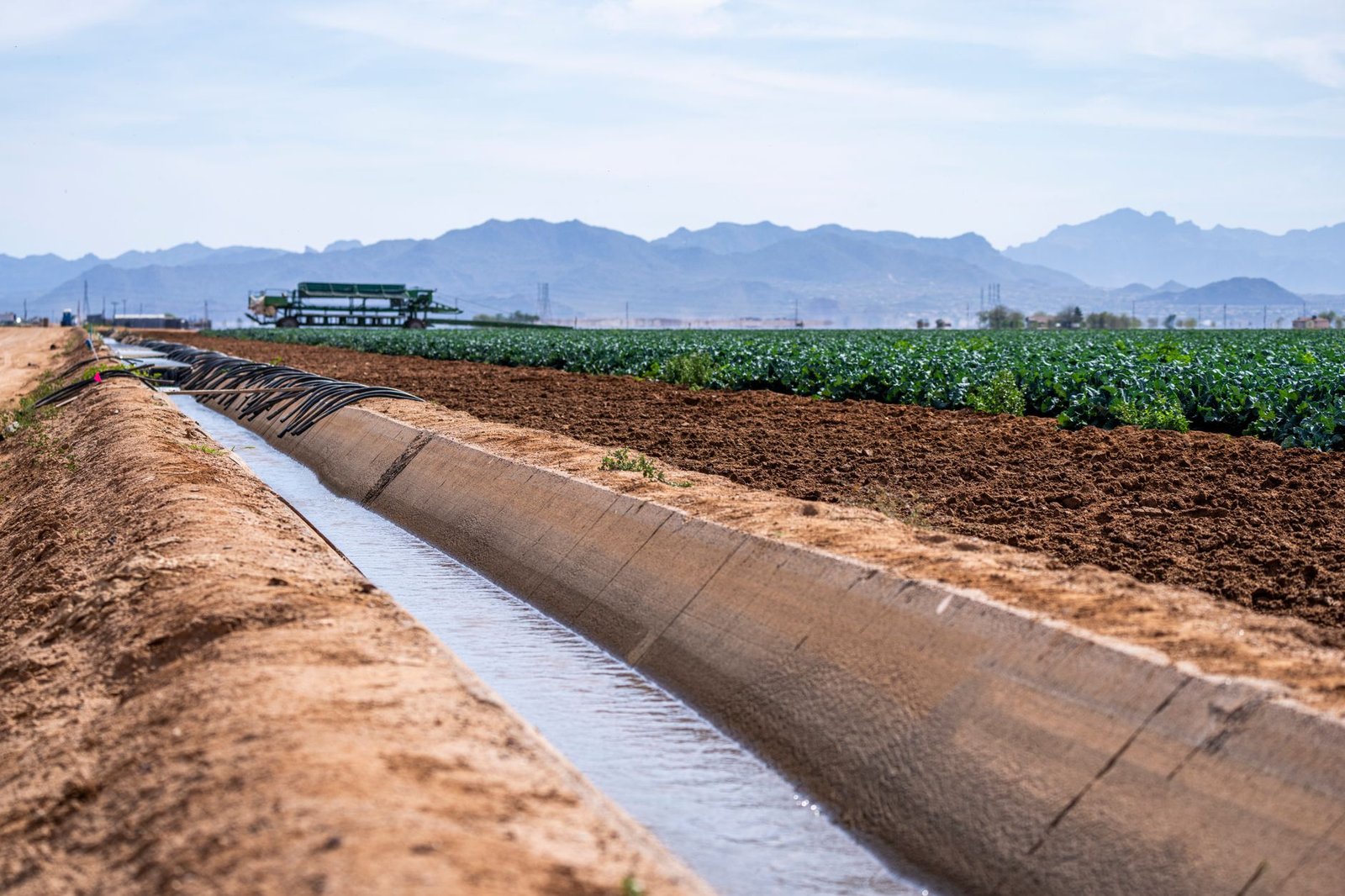
Arid agriculture in the Middle East faces an escalating biophysical constraint: hyper-sandy soil structures characterized by high hydraulic conductivity and near-zero cation exchange capacity. In regions such as the United Arab Emirates and Saudi Arabia, over 80% of local freshwater withdrawals are allocated to agricultural operations, yet standard crop irrigation loses as much as 60% of applied water directly to deep percolation past the root zone. Desert Control, a climate-tech enterprise listed on Euronext Growth Oslo, has developed an intervention to address this mechanical failure point through its patented Liquid NanoClay Soil Technology.
The Arid Agricultural Paradox and Structural Water Inefficiency
The core challenge of desert cultivation is soil physics, not ambient heat alone. Desert sands are largely composed of coarse quartz particles measuring 0.05 to 2.0 mm in diameter. Due to negligible structural cohesion, these soils exhibit gravitational drainage rates that outpace root uptake velocities. Farmers traditionally offset this deficit through continuous, excessive aquifer extraction or high-energy desalination networks, driving production expenditures to unstabilized levels.
Macroeconomic Pressures Across the GCC
GCC governments have instituted ambitious national food security strategies, such as the UAE National Food Security Strategy 2051 and Saudi Arabia’s Vision 2030 domestic production targets. Achieving these benchmarks requires an operational decoupling of agricultural output from raw groundwater depletion. Desalinated water carries an embedded energy cost of roughly 3.5 to 4.5 kWh per cubic meter, rendering broadacre conventional irrigation fiscally non-viable without heavy state subsidies. Modifying the physical hydraulic profile of the soil itself has become an economic imperative.
| Metric | Untreated Arid Sand | LNC-Treated Arid Sand | Operational Impact |
|---|---|---|---|
| Water Retention Index | Baseline (1.0x) | 3.0x to 4.5x | Sustained root-zone moisture |
| Irrigation Requirement | 100% (Standard) | 50% to 65% | Direct reduction in water procurement costs |
| Percolation Loss Rate | Extreme (>150 mm/hr) | Controlled (<30 mm/hr) | Prevents nutrient leaching below root zone |
| Time to Soil Transformation | Up to 10–15 years (organic) | Under 7 hours | Immediate agronomic viability |
The Physics of Liquid NanoClay Soil Technology
Desert Control’s proprietary innovation lies in a physical-mechanical process that binds common bentonite clay platelets with water without chemical additives. Under standard conditions, dry bentonite swells into an impermeable, high-viscosity sludge that cannot percolate through sand without clogging surface strata. Desert Control utilizes specialized shear-mixing equipment to separate clay particles down to the individual platelet level (1 to 100 nanometers), creating a fluid dispersion matching the viscosity of pure water.
The 7-Hour Micro-Membrane Transformation
When deployed through standard center-pivot, micro-sprinkler, or drip irrigation systems, this fluid mixture percolates evenly through the target sand column. As it filters through, individual nanoclay platelets adhere to the surfaces of the sand grains, forming an interconnected 200-to-300-nanometer micro-structural coating. This process converts non-cohesive sandy substrates into a sponge-like network with dramatically elevated specific surface areas. The transformation achieves field stabilization within 7 hours of application, bypassing the decadal timelines previously required for biological soil conditioning.
- Hydraulic Capillarity: Increases unsaturated capillary suction, drawing water horizontally across root systems rather than losing it downward.
- Nutrient Immobilization: Enhances the effective cation-exchange capacity (CEC), retaining synthetic and organic fertilizers within the top 40 centimeters of soil.
- Biomass Yield: Documented pilot operations show identical or higher crop yields despite cutbacks in gross water application.
Commercial Execution: The Desert Control Operating Model
Scaling a deep-tech process in agricultural supply chains requires mitigating upfront capital expenditure (CapEx) hurdles for conservative farm operators. Desert Control approaches commercial deployment through structured services and joint ventures rather than pure raw-material distribution.
Mobile Production Infrastructure
The company deploys modular, containerized production units (OASIS machines) directly to operational agricultural sites. These units intake locally sourced clay minerals and water, converting them into Liquid NanoClay at a point-of-use scale. By producing the liquid suspension directly in the field, Desert Control eliminates the prohibitive logistical expense of transporting heavy liquid mixtures across transcontinental freight routes.
Deployment Economics and Revenue Streams
The commercial architecture is structured across three monetization tiers:
- Agricultural Soil Treatment-as-a-Service: Large-scale food producers pay per-hectare application fees, recovering the investment via water utility savings and fertilizer preservation over multi-year cycles.
- Municipal and Urban Landscaping: Strategic partnerships with metropolitan agencies and commercial real estate developers to preserve green belts, urban forestry, and parks while meeting strict regional municipal water quotas.
- Joint Ventures in Key Geographies: In the Middle East, Desert Control partnered with regional giants like Barhy and other institutional agribusinesses to accelerate channel access across hundreds of thousands of cultivated hectares.
Scalability Constraints and Engineering Headwinds
Despite robust empirical validation, broad-scale commercial expansion presents distinct technical challenges. Sourcing high-grade bentonite clay requires reliable, localized mineral supply chains to maintain operational margins. Furthermore, long-term soil cohesion requires longitudinal evaluation: hyper-saline groundwaters, common in hyper-arid farming, can induce flocculation or alter the electrical double layer of clay particles, potentially attenuating the micro-structural coating over multi-year periods. Re-application intervals, typically estimated at three to five years, require predictive modeling calibrated to soil chemistry and crop rotation cycles.
Global Expansion Vectors: Beyond the Middle East
While the GCC serves as the primary proving ground due to acute resource pressure and state capital alignment, Liquid NanoClay Soil Technology possesses clear vector applications across broader arid and semi-arid export zones. In regions such as the American Southwest (Central Valley and Colorado River Basin), prolonged drought cycles and regulatory water restrictions threaten the viability of permanent crop assets. Expanding into these commercial regions repositions Liquid NanoClay from an arid emergency intervention to an essential asset-protection tool for global agricultural risk mitigation.




Discussion (0)