

The Arid Zone Trilemma: Groundwater Depletion, Desalination Costs, and Food Security
The Gulf Cooperation Council (GCC) operates under one of the world’s most severe structural resource imbalances. While the region accounts for roughly 5% of the global population, it commands less than 1% of the world’s renewable freshwater resources. Historically, member states relied on two unsustainable vectors to fuel urban growth and primary industries: non-renewable fossil aquifers and fossil-fuel-intensive thermal desalination. In the United Arab Emirates, agricultural activities consume over 60% of total available water, yet domestic farming contributes less than 1% to national GDP. This asymmetry presents a clear risk to fiscal stability and long-term food resilience.
Subsurface aquifer extraction rates across the Arabian Peninsula exceed natural recharge rates by an estimated factor of fifteen. The outcome has been predictable: falling water tables, hyper-salinization of agricultural wells, and land degradation across key farming belts such as Al Ain and Liwa. Conversely, producing municipal irrigation water via conventional Seawater Reverse Osmosis (SWRO) or Multi-Stage Flash (MSF) distillation carries an unsustainable carbon and operational expense profile. Thermal desalination requires between 10 to 15 kWh of primary energy per cubic meter, while modern SWRO remains capital-intensive and burdened by brine management liabilities. To achieve national food security targets without inflating sovereign energy subsidies, the regional industrial framework requires a decoupled, high-yield source of industrial-grade water. This systemic pressure sets the baseline for recycled water agriculture GCC strategies.
SWS Strategic Playbook: Infrastructure, Purification, and Conveyance
Sustainable Water Solutions (SWS Holding)—formerly Abu Dhabi Sewerage Services Company (ADSSC) and integrated into the sovereign utility platform alongside TAQA—operates as the core infrastructure orchestrator for wastewater valorization in Abu Dhabi. The utility manages an asset footprint capable of treating over 1.3 million cubic meters of wastewater per day across core facilities including the Al Wathba and Al Saad independent wastewater treatment plants (ISTPs). SWS has re-engineered its operational focus from simple municipal waste abatement to secondary raw material synthesis.
The engineering topology deployed across SWS assets targets international Class A reclaimed water standards. The processing sequence integrates multi-barrier physical and biological separation stages designed to neutralize pathogens, reduce biological oxygen demand (BOD), and eliminate heavy metals:
- Primary Clarification and Advanced Secondary Treatment: Large-scale biological nutrient removal (BNR) alongside anoxic/aerobic activated sludge configurations to strip nitrates and phosphorus.
- Tertiary Membrane Filtration: Ultrafiltration (UF) and Membrane Bioreactor (MBR) modules functioning at pore sizes below 0.04 microns, eliminating micro-particulates and viral loads.
- Advanced Oxidation and Disinfection: High-output ultraviolet (UV) irradiation paired with secondary chlorination to deliver sustained residual disinfection across municipal transport corridors.
- Trace Desalination via Polishing RO: Dedicated reverse osmosis polishers deployed at select distribution nodes to lower Total Dissolved Solids (TDS) from 1,200 ppm to below 400 ppm, preventing soil calcification in vulnerable agricultural cultivars.
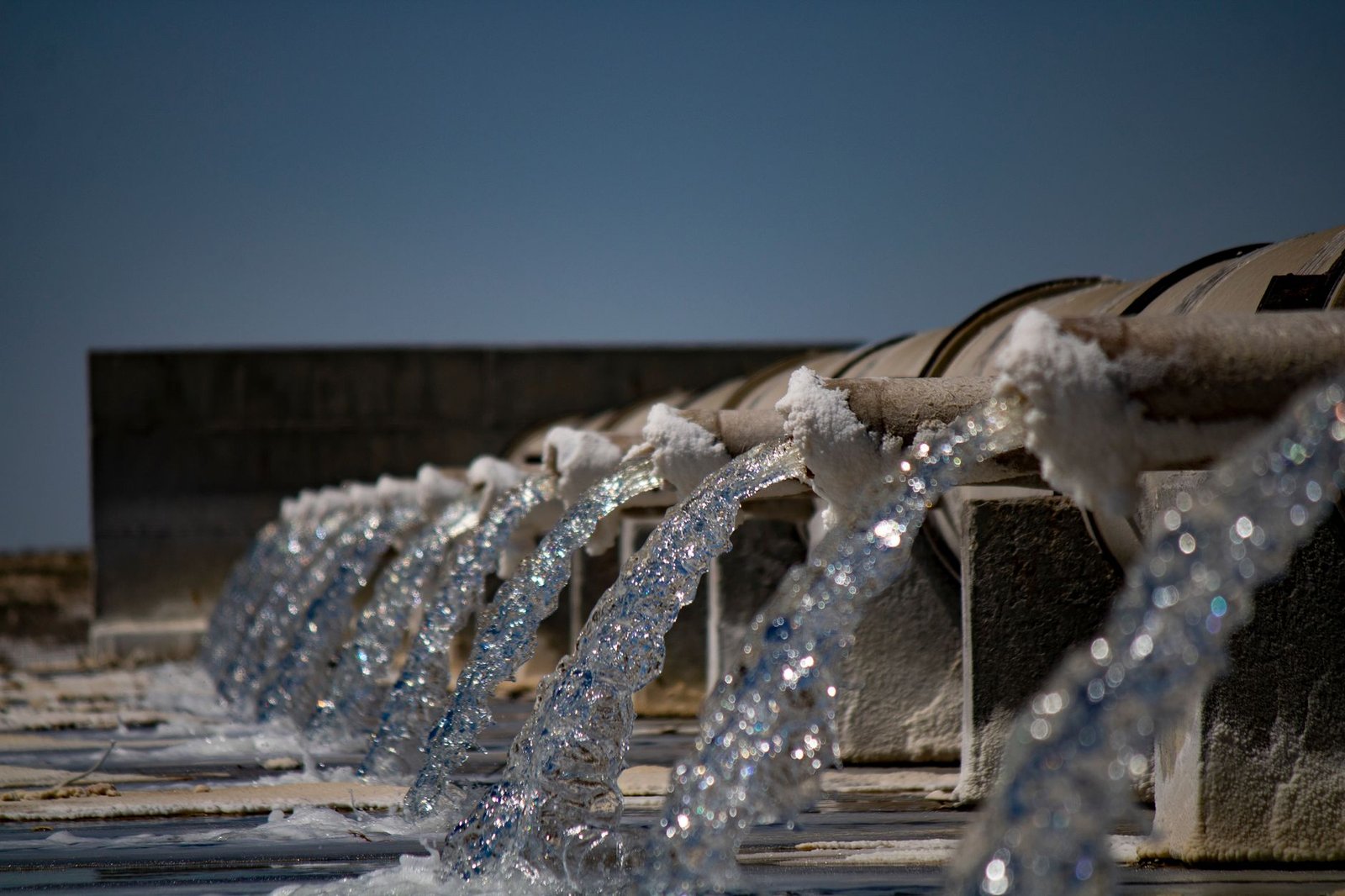
Processing capacity without conveyance is stranded capital. To solve the distribution bottleneck, Abu Dhabi executed massive midstream pipeline projects connecting centralized urban wastewater facilities with rural farming collectives. The flagship transmission lines pump hundreds of millions of liters of treated sewage effluent (TSE) daily across tens of kilometers of carbon-steel and ductile iron conduits. By routing Class A reclaimed water directly to the farm-gate in Al Khatim, Sweihan, and Al Ain, SWS transformed effluent disposal into a closed-loop economic hedge against groundwater depletion.
Economics of Water Valorization: CapEx, OpEx, and Tariff Realities
The economic logic of recycled water agriculture GCC models is rooted in levelized cost metrics. Producing one cubic meter of treated water via municipal wastewater reuse is structurally cheaper and significantly less energy-intensive than seawater desalination.
| Metric / Water Source | Thermal Desalination (MSF/MED) | Seawater Reverse Osmosis (SWRO) | Treated Sewage Effluent (TSE/MBR) |
|---|---|---|---|
| Specific Energy Consumption (kWh/m³) | 10.0 – 15.0 | 3.0 – 4.2 | 0.8 – 1.4 |
| Levelized Cost of Water (USD/m³) | $1.20 – $1.80 | $0.70 – $0.95 | $0.30 – $0.50 |
| Carbon Intensity (kg CO₂e/m³) | 8.5 – 12.0 | 2.1 – 3.2 | 0.4 – 0.9 |
| Brine / Residual Disposal Risk | Extreme (Marine Hyper-Salinity) | High (Marine Environmental Impact) | Low (Sludge Valorization/Biosolids) |
| Upfront Distribution CapEx | Medium (Coastal Centric) | Medium (Coastal Centric) | High (Inland Conduit Networks) |
As illustrated, the Levelized Cost of Water (LCOW) for high-grade TSE sits roughly 40% to 50% below state-of-the-art seawater RO and up to 75% below legacy thermal plants. The specific energy consumption of 0.8 to 1.4 kWh/m³ makes reclaimed water a viable conduit for meeting corporate Scope 2 decarbonization targets under the UAE Net Zero 2050 charter.
To convert this operational delta into balance-sheet durability, SWS structured long-term supply frameworks with agricultural conglomerates like Silal. Farmers receive reliable water volumes through off-take agreements backed by targeted government incentives. Rather than subsidizing high-cost diesel pumps that drain saline wells, the state redirect funds into modernizing on-farm drip irrigation systems calibrated for TSE. This structure shifts agricultural economics from unmonitored ecological liquidation toward metered, industrial-grade resource usage.
Industrial Symbiosis and High-Value Biosolids
Wastewater valorization produces two primary product streams: polished industrial-grade water and solid organic waste. SWS treats these streams as co-equal revenue and decarbonization vectors. Beyond supplying farms and biosaline forestry projects, SWS provides high-spec recycled water to municipal cooling networks (District Cooling) operated by entities like Tabreed. District cooling plants running on reclaimed water eliminate the burning of desalinated drinking water inside evaporative cooling towers, freeing premium potable water for municipal grids.
Concurrently, the treatment process yields tens of thousands of metric tons of sewage sludge annually. SWS has operationalized advanced thermal drying and anaerobic digestion facilities to convert this secondary stream into Class A biosolids and biosolid-derived fuel. By transforming nutrient-rich sludge into certified agricultural soil conditioners and auxiliary fuels for cement kilns, the platform closes the circular economy loop while generating secondary, non-regulated margin streams.
Exporting Hyper-Arid Resilience: The Desert-to-Global Blueprint
The operational maturity demonstrated by SWS in Abu Dhabi presents substantial export value. The macro drivers shaping the GCC’s water strategy—groundwater collapse, rapid urban clustering, demographic pressure, and industrial reshoring—are accelerating across other major markets, including Central Asia, North Africa, Latin America, and the American Southwest.
SWS’s competitive advantage does not stem solely from proprietary hardware; it is built on platform integration. The ability to coordinate sovereign-level environmental policy, long-term concession structures, multi-tiered EPC execution, and end-user off-take networks allows GCC utilities to compete globally for wastewater asset concessions. As sovereigns across the MENA belt look to replicate the UAE model, SWS sits as an execution vehicle capable of entering public-private partnerships (PPPs) overseas.
For global institutional investors, infrastructure funds, and sovereign policymakers, the operational architecture established by SWS provides a quantitative lesson: hyper-arid regions cannot balance agricultural output, industrial manufacturing, and balance-sheet liquidity using single-pass water models. Wastewater reclamation is not an environmental concession; it is an industrial prerequisite for economic continuity in an era of accelerating climate and resource volatility.

Discussion (0)